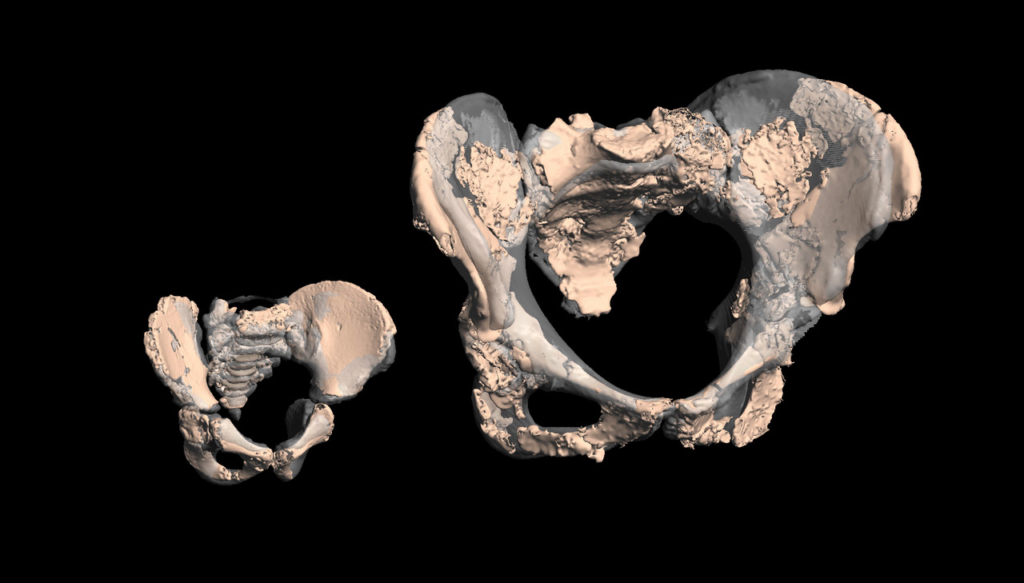
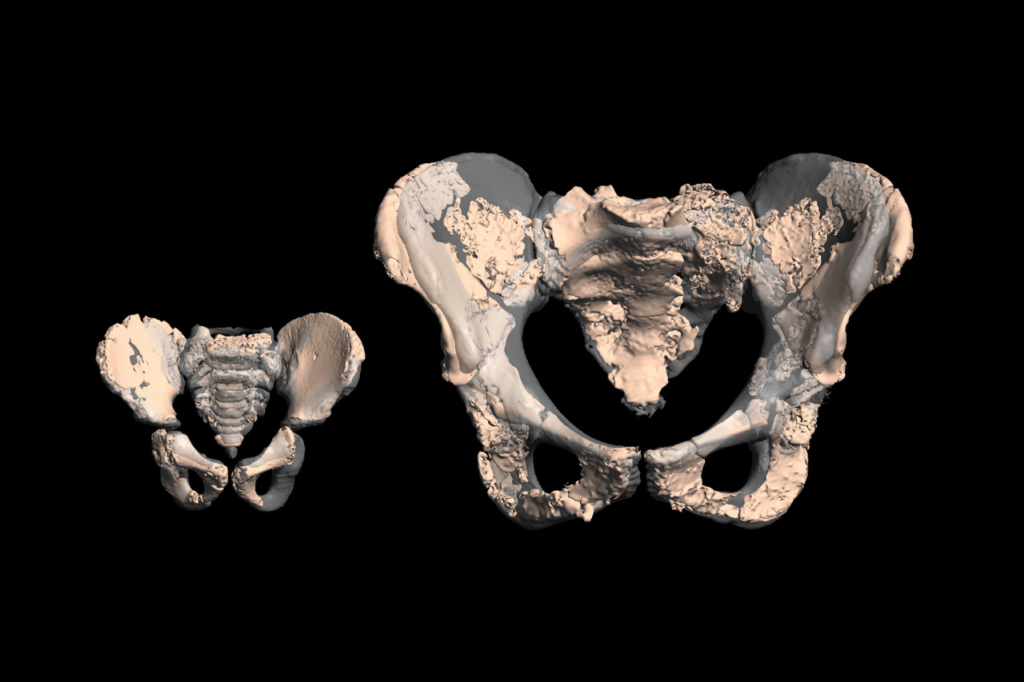
For decades, the “obstetrical dilemma” hypothesis has been the standard explanation for the shape of the human pelvis, suggesting it is a compromise between the need to give birth to large-brained babies and the need to walk efficiently on two legs. However, a new study published today in the Proceedings of the National Academy of Sciences (PNAS) is turning this theory on its head.
By performing and analyzing virtual reconstructions of nearly complete Neanderthal pelvises from Sima de las Palomas (Spain) and Dederiyeh Cave (Syria), researchers discovered that the evolutionary trade-off isn’t actually between childbirth and walking. Instead, the evidence suggests the real conflict is between childbirth and pelvic floor stability. While the internal regions of the pelvis relevant for childbirth are remarkably similar between Neanderthals and modern humans, the external parts linked to locomotion are distinct. This suggests that walking efficiency was not the primary constraint limiting the birth canal.
The species-specific pelvic shapes aren’t just a result of adult life. A reconstruction of a 1.5-year-old Neanderthal infant showed characteristic flaring hips and a wider frame, suggesting these traits were starting to develop before the infant took its first steps. Neanderthal pelvic anatomy likely prioritized trunk stability and power stride over the endurance running capabilities seen in modern humans.
Despite their different pelvic shapes, both species share similar patterns of sexual dimorphism, suggesting that the challenges of birthing large-headed infants while maintaining pelvic floor stability have been a constant for hundreds of thousands of years.
The study also challenges the long-standing “Neanderthal cold-adaptation” hypothesis, finding that their pelvic surface-to-volume ratios fall within the range of modern human variation.
This research shifts our understanding of human evolution from a simple “birth vs. walking” story to a more complex “multifactor pelvis” model, where stability, locomotion, and childbearing all play competing roles in shaping our bodies. As the lead researchers note, these findings offer a “revised perspective on a long-standing evolutionary hypothesis,” suggesting our ancestors were far better adapted to their unique lifestyles than we previously realized.
Reference information:
– Journal: Proceedings of the National Academy of Sciences (PNAS)
– Article Title: “Insights into Neanderthal development, childbirth, and locomotion from the Palomas and Dederiyeh pelves”
– Authors: Christoph P. E. Zollikofer, Marcia S. Ponce de León, MariaHaber Uriarte, Mariano López, Jon Ortega, Osamu Kondo, Takeru Akazawa, Michael J. Walker.
– Direct Link:https://doi.org/10.1073/pnas.2535303123 (open access)
Media contact information:
Christoph P. E. Zollikofer (zolli@ifi.uzh.ch, +41 79 778 04 55) and Marcia S. Ponce de León (marcia@ifi.uzh.ch), Department of Informatics, University of Zurich, Switzerland, and Center for Climate Physics, Institute for Basic Science, Busan, Republic of Korea.
Michael J. Walker (mjwalke@gmail.com), Murcian Association for the Study of Palaeoanthropology and the Quaternary, Murcia, Spain.